The direct synthesis of ammonia (NH3) from nitrogen (N2) and water (H2O) under mild conditions presents a promising pathway for energy-efficient and sustainable NH3 production. However, thermocatalytic NH3 synthesis from N2 and H2O is limited by unfavorable reaction thermodynamics. In addition, the presence of H2O strongly suppresses N2 activation, as traditional catalysts such as Ru and Fe bind H2O more strongly than N2. As a result, direct thermocatalytic NH3 synthesis from N2 and H2O has remained elusive.
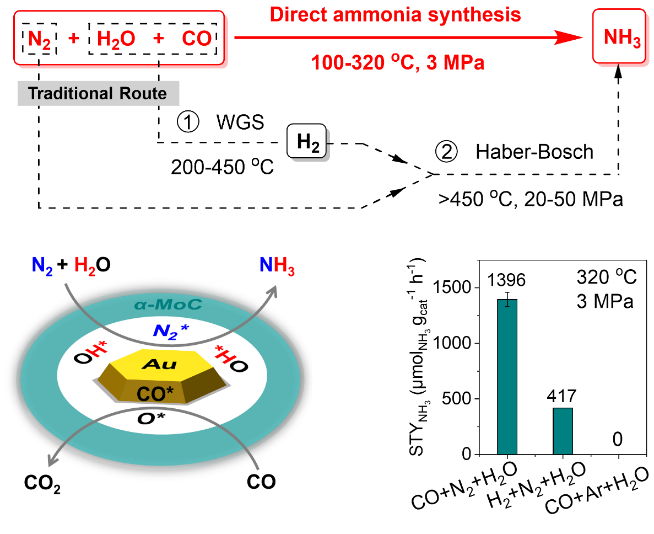
Direct ammonia synthesis from nitrogen and waterat mild conditions (Image by ZHAO Baibei)
In a study published in Journal of the American Chemical Society, a research team led by Prof. DENG Dehui, Prof. HUANG Rui, and Prof. YU Liang from the Dalian Institute of Chemical Physics (DICP) of the Chinese Academy of Sciences (CAS) achieved NH3 synthesis directly from N2 and H2O under mild conditions by introducing carbon monoxide (CO) into the reaction system to regulate overall reaction thermodynamics. Using a bifunctional Au/α-MoC1-x catalyst, the team achieves an NH3 production rate of 61 μmolNH3 gcat-1 h-1 at 100 °C, and 1,396 μmolNH3 gcat-1 h-1 at 320 °C, higher than other single-function catalysts.
Researchers revealed that the α-MoC1-x phase provides active Mo sites for N2 adsorption and H2O dissociation, while Auδ+ species selectively adsorb CO, promoting the removal of surface oxygen and regenerating active Mo sites. This dual functionality enables a continuous catalytic cycle in which N2 is activated and hydrogenated by in situ-generated OH* species to form NH3.
"Our study opens new avenues for energy-efficient NH3 production using water as the hydrogen source," said Prof. DENG.