Perovskite materials are widely regarded as strong contenders for next-generation solar cells due to their outstanding optoelectronic properties. However, during the fabrication of perovskite polycrystalline films, nonuniform stress inevitably develops along the vertical direction. This uneven stress distribution induces defect formation and accelerates ion migration, ultimately limiting both the power conversion efficiency (PCE) and long-term stability of perovskite solar cells.
In a recent study published in Advanced Materials, a research team led by Prof. YANG Dong from the Dalian Institute of Chemical Physics (DICP) of the Chinese Academy of Sciences (CAS) proposed a novel strategy to achieve uniform vertical stress regulation in perovskite films through the construction of interfacial pre-stress.
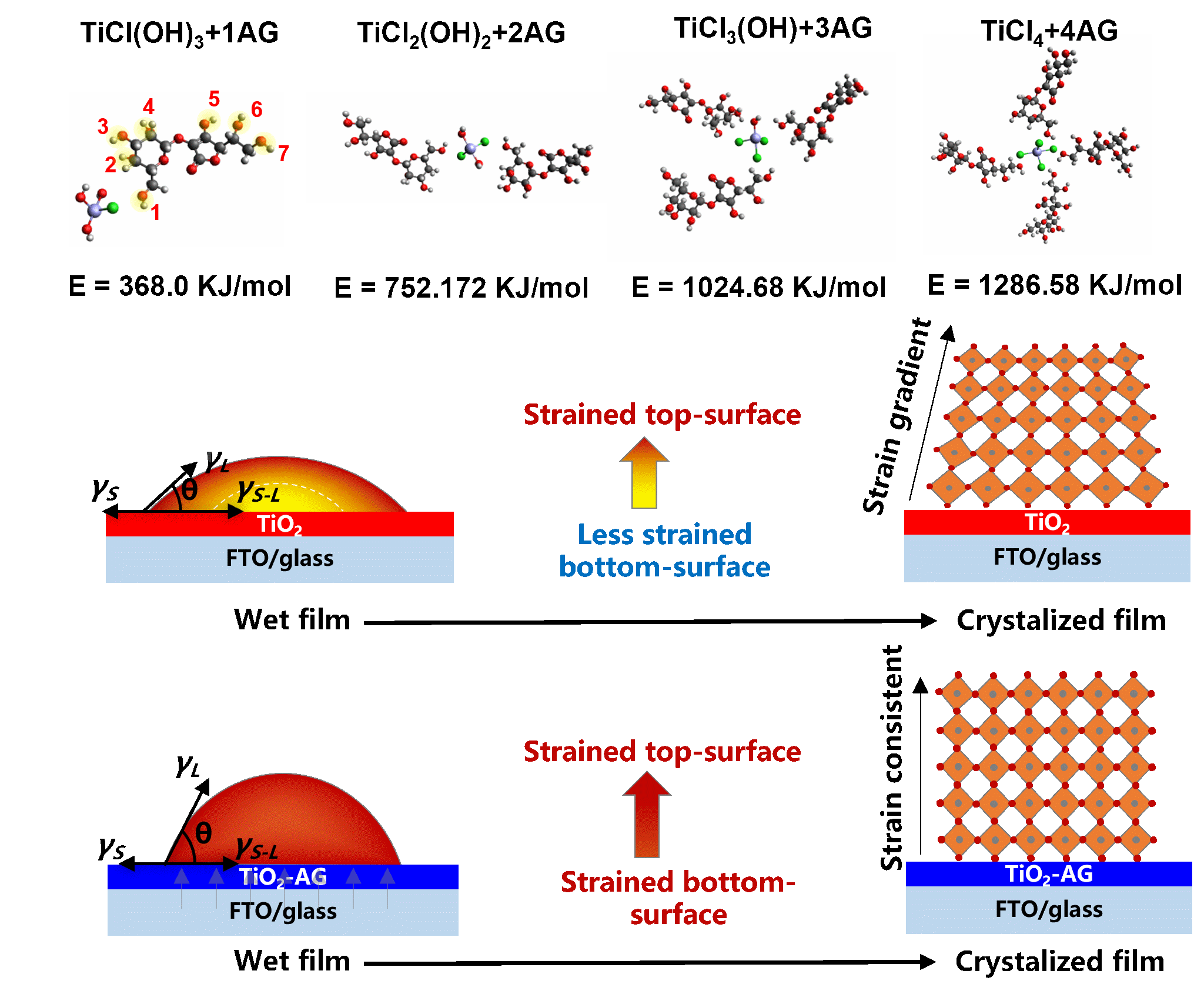
Schematic Diagrams of Possible Configurations with Enthalpy Values for Ti(OH)4−x(AG)x (1≤x≤4) and Interface Stress Analysis (Image by DUAN Lianjie)
Researchers incorporated ascorbyl glucoside into TiO2 nanocrystals synthesized hydrothermally from TiCl4, thereby reducing the surface energy of the TiO2 electron transport layer and inducing lattice stress relaxation in the bottom region of the perovskite film at the liquid/solid/air triple-phase interface. By precisely regulating the crystallization dynamics at this interface, the crystallization quality and microstructural uniformity of the perovskite film were improved.
As a result, perovskite film with highly uniform vertical stress distribution and compressive strain were obtained. Correspondingly, the PCE of perovskite solar cells increased markedly from 23.20% to 25.34%. Moreover, the devices exhibited good long-term operational stability, retaining more than 95% of their initial efficiency after over 2,000 hours of continuous operation.
"This work deepens the understanding of the origin and evolution of stress in perovskite film and provides a generalizable interfacial engineering strategy for regulating intrinsic properties of materials," said Prof. YANG.