Global annual plastic production exceeds 360 million tons, with polyolefinssuch as high-density polyethylene (HDPE), low-density polyethylene (LDPE), polypropylene (PP), and polystyrene (PS) accounting for over half. Despite their widespread use, these plastics face abysmal recycling rates due to their exceptional chemical stability, which demands massive energy input for breakdown. Compounding the issue, poly(vinyl chloride) (PVC), a common component in mixed plastic waste, poses unique hazards: it releases corrosive hydrogen chloride during recycling, causing reactor damage and catalyst poisoning, while its plasticizers hinder the recyclability of both PVC and mixed plastics.
In a recent study published in Nature Communications, a research group led by Prof. CHEN Qingan from the Dalian Institute of Chemical Physics (DICP) of the Chinese Academy of Sciences (CAS) has proposed an innovative plastic recycling strategy, converting waste PVC into a photothermal agent to depolymerize polyolefins under sunlight. This study addresses challenges of high energy consumption in polyolefin recycling and PVC's problematic degradation.
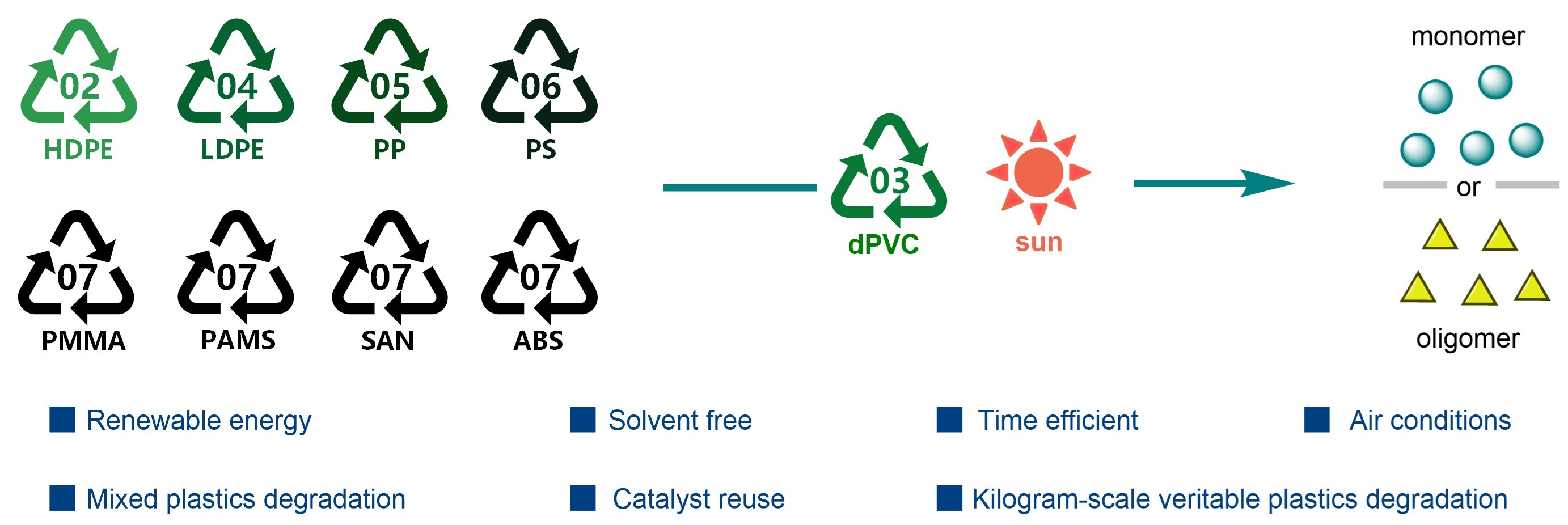
A strategy for recycling of polyolefins using recycled PVC under sunlight (Image by LIU Heng)
The team's solution starts with dechlorinating PVC. Using an alkyl bromide-catalyzed process, they transformed waste PVC (e.g., gloves, tubings) into a black photothermal agent (dPVC). dPVC absorbs more than 90% of visible sunlight, enabling rapid heating of reaction systems under concentrated irradiation to temperatures sufficient for cleaving C-C bonds in polyolefins.
In experiments, HDPE, LDPE, and PP were converted into terminal olefin-rich waxes within 2-3 minutes. PS, poly(methyl methacrylate) (PMMA), and copolymers like styrene-acrylonitrile (SAN)/acrylonitrile-butadiene-styrene (ABS) were depolymerized into their monomers. Crucially, the method worked for mixed post-consumer plastics (avoiding sorting) and scaled to kilogram-scale: 1 kg of PS cups yielded 0.97 kg of liquid product (57wt% styrene) with only 0.1wt% dPVC. dPVC also showed excellent reusability, maintaining efficiency over 10 cycles, and enhanced thermal stability after use, thanks to further chlorine elimination and increased conjugation.
"This work turns waste PVC from a liability into a resource. By harnessing solar energy, it reduces fossil fuel reliance and greenhouse gas emissions, offering a practical path for circular plastic economy," said Prof. CHEN.